Best DeFi Platforms to Explore in 2025 To Launch Your Own in 2026
October 17, 2025

share


share
During the last bull market, DeFi was at its prime clocking new ATHs from $1 B to $260 B in a matter of 12 months because new and innovative solutions changed the face of finance. Fast forward to 2025, the momentum has been consolidating and the peak run has fallen from the grace from $250B to $101 B .
But despite the pessimism, some of the platforms are still staying dominant and buzzing in the DeFi space. In this piece, we shall see what these platforms are doing to stay relevant. For that matter, we have picked two zoners (i) Perps (ii) Lending & Borrowing. In this segment, we have hand picked two projects each to study what they are doing extensively to pull the audience towards them.
If you are someone who wishes to build around DeFi in 2026, this is the guide that you wouldn’t afford to miss. So, let’s jump to the top protocols across the above mentioned segments and find out how they are staying relevant even when there’s very little market movements;
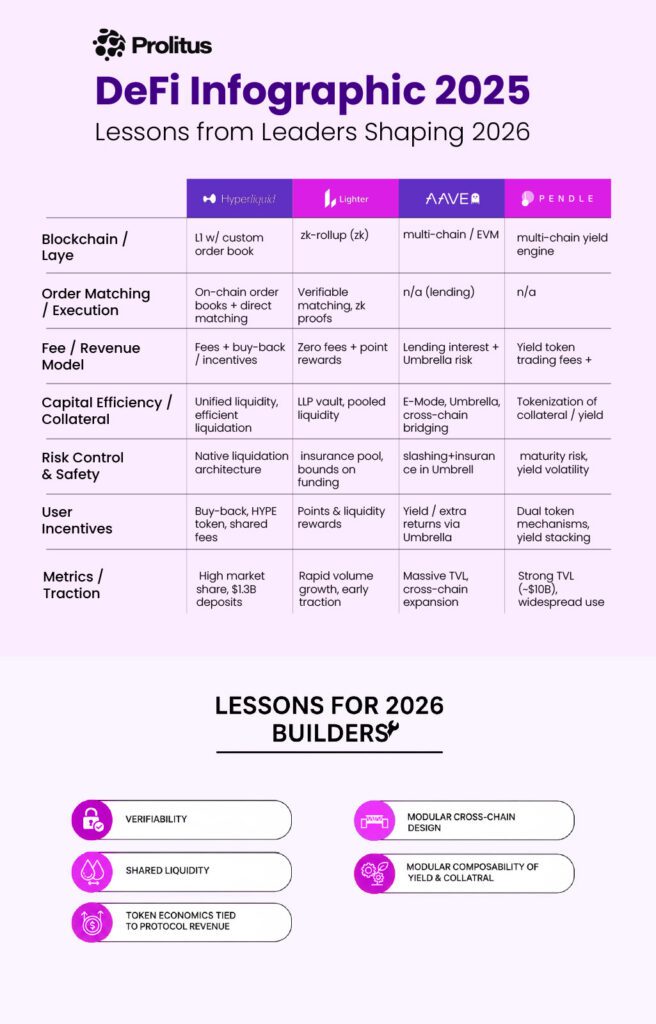
In the last few days, Hyperliquid has processed over $10 B in liquidations. These numbers are enough to make anyone numb because the crypto movement has touched new lows and the sentiments around crypto trading isn’t at its peak. Despite this fact, Hyperliquid still maintains a dominant position with respect to user traction because they provided the following trade-offs that users were looking for; ;
In this way, they have pushed the incentives to hold the HYPE Token and there are multiple whales who are on a spree to HODL the HYPE Token as evident from more than 600,000 active wallets created in 2025 alone. And this is happening without an airdrop orchestrated, signalling a very strong strategy to bind users to the protocol through super high yields.
To put it simply, during a dull/bear market, HyperLiquid introduces a funding rate mechanism which can balance the short and long position to incentive traders. So, if anyone is going too long, the short traders are incentivized to bring back the price to normalcy. Thereby checking the market movements and generating fees in the process to keep the platform up and running.
This method has abstracted the need to lock-in 15% of the total supply earmarked for the exchange itself . In this way, it has completely bypassed the need to lock in tokens to get listed on top platforms for trading. Thereby attracting so much traction that hyperliquid is seeing. The below given tweet justifies that despite the market downturns, the following features that HyperLiquid introduces has made it a go-to platform for users;
Though Hyper-Liquid has remained on top with $70 B in trading volume, it will be an understatement to ignore Lighter from this competition because on some grounds Lighter has outsmarted Hyper-liquid, like for example, TVL. At the same time, despite being moved from a Beta mode to full fledged launch on Oct 2, 2025, ,the DEX has already scaled $5.2B in volume because there are some features that Lighter has delivered upon which users are currently looking for like;
AAVE has remained relevant all these years despite starting up in 2017 because they have evolved with time. For example, during their inception, they rolled out as a lending and borrowing platform, but later on, they introduced flash loans as a concept that took the market by storm in 2020. In 2025, AAVE is all set to introduce advanced features to further bind users because only then can they maintain the 52% TVL journey and 60% capitalization on lending they have been able to achieve so far. And to do that, there’s only one way to get that, through innovations which AAVE has delivered through the following updates;
Like AAVE capitalizing 60% of the market share in lending & borrowing, Pendle Fi has done the same in the Yield generation category by capitalizing on 50% of the market value. But dominating 50% market share demands peak level innovation because so far Element, APWine, Spectra, and Napier already provided yield generation but there were some areas that they couldn’t touch. For example,
Treasuries and yield managers are attracted because they can use an existing capital to generate fresh revenue streams and use the new tokens created from an existing capital to create a new capital account. For example, you use $1000 as capital to generate $10 as Yield. Now, you use $10 as fresh capital to buy another YT from some of the stakers and earn interest on them as per the market sentiments to make more profits.
These features have helped Pendle Fi remain resilient and running even during the times of market crash that happened just a few days ago. Users are still very active on Pendle Fi because they are getting more than what they could ever get in DeFi Yield Generation.
All these protocols have remained relevant despite the changing times because they provided out of the box solutions to some of the pressing problems plaguing the DeFi space. If you are looking forward to building such innovative solutions around DeFi, you need a trusted partner where Prolitus fits in.
Prolitus has over a decade of experience building on top of blockchains various platforms from Dapps, marketplaces, exchanges to gaming apps. If you want to build your own DeFi Native protocol on blockchains across DEX, lending & borrowing, Perps or more, we can help you in all the pursuits.
So far, we have served many projects in the Web 3gaming, NFTs, Dex and exchange segments. By using our seasoned professionals having years of experience, we have provided the best outcomes to all the clients served. If you are looking for similar expertise, innovation, and comprehensive support to build your DeFi native protocol on blockchains as an exchange, lending or borrowing platform or perps, prediction markets so on and so forth from the scratch in a completely frictionless manner, we are here to help you. For queries about how we can streamline the process and help you in developing your compliant ATS on blockchain for RWAs, we are just a call away from you.