Best Smart Contract Development Platforms That Won’t Let You Fail in 2026
October 13, 2025

share


share
It wouldn’t be an understatement to say that smart contracts are building blocks of Web3 because they are powering up Web3’s emerging use-cases like: BFSI, transportation and logistics, healthcare, government and public use cases, RWAs, and many other crypto Twitter narratives, like DeFAI, prediction markets, AI x Robotics, DePIN, and more.
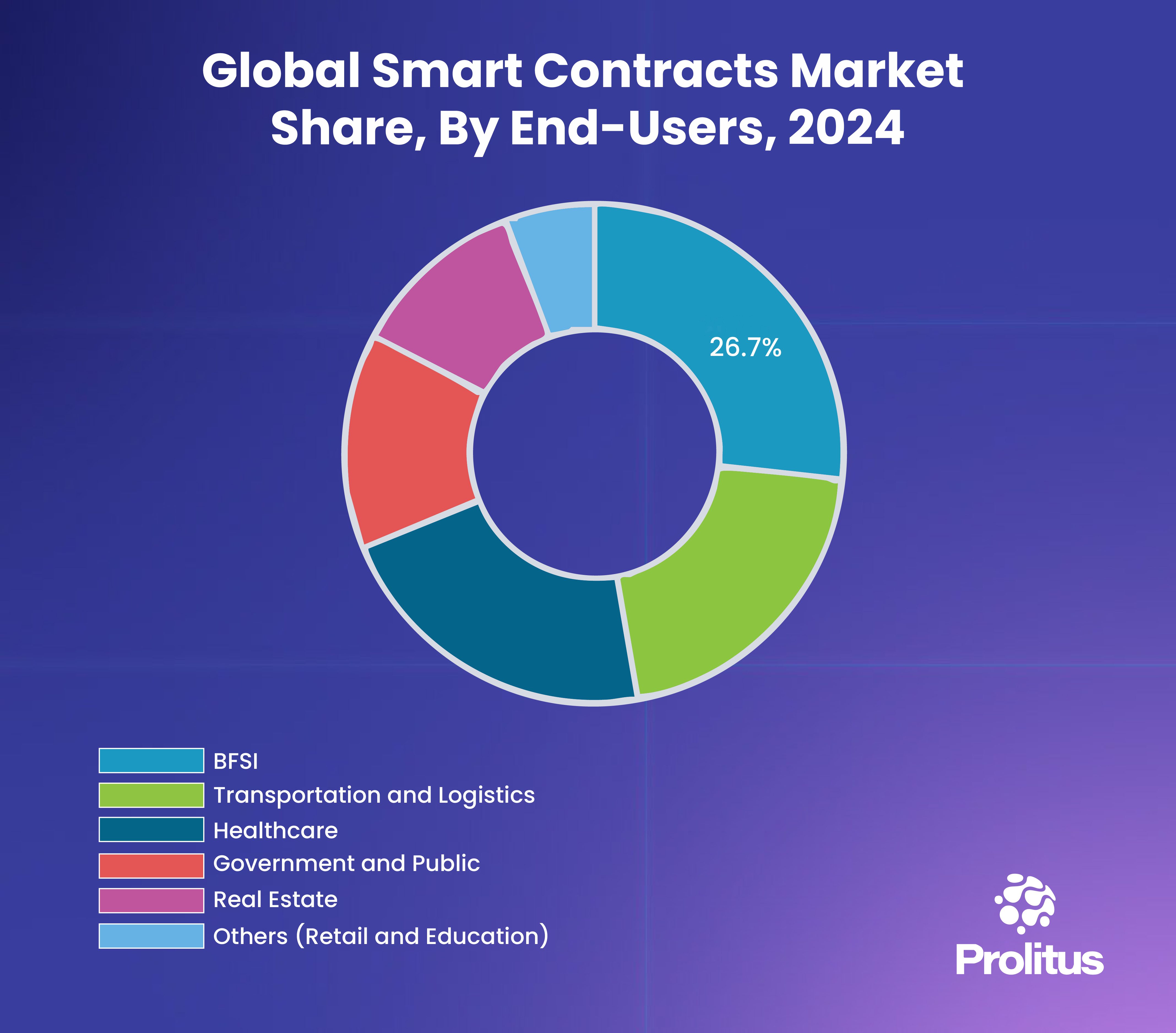
Due to this, they are showing significant adoption with time, growing at a 24.7% CAGR and expected to turn $12.55 billion by 2032.
But they can backfire at any moment when you pick a non-performant blockchain to deploy your smart contract. In this blog, we shall see some of the best blockchains that are best for smart contract deployments in 2025 and how projects are using them.
Just a few years ago, who would have thought that Solana would be topping the charts when we are speaking of the top blockchains to deploy smart contracts, but in the last few months, some ace upgrades have completely flipped the game, pushing the smart contract developed on Solana from 420 in 2022 to 8400 in 2025, like.
Before jumping into the heavy lifting, let’s ease in with Solana’s core language—Rust. Smart contracts on Solana are primarily written in Rust, a memory-safe and performant language that catches errors early and handles high-speed execution without the headaches of less robust options like older scripting languages. It’s approachable for devs coming from systems programming, and lets you focus on logic like token swaps or AI triggers rather than fighting endless bugs. From here, Solana’s architecture builds naturally on Rust’s strengths for seamless scaling.
Deploying your smart contract also comes with an imminent risk that you have to bid for extra space. For example, if you want to run a program that is occupying, say, 1 MB of space, you need to lock in an additional 1 MB for upgrades, which boils down to spending more to deploy your smart contract. Solana’s 2025 updates, like ZK Compression and P-Token optimizations, have simply brought that cost down—slashing compute by 95%+ and benefiting large programs to be deployed on the blockchain without breaking the bank.
Projects Using These Custom Features to Deploy:
As of October 2025, Solana’s ecosystem has exploded, with DeFi TVL surpassing $12.4 billion and dApp revenue hitting $1.69 billion year-to-date—more than the full 2024 total. This growth is driven by high-throughput upgrades and a surge in DeFi, memecoins, staking, and AI-integrated apps. Based on TVL, trading volume, user activity, and revenue metrics, Jupiter Exchange, Jito, Raydium, Pump.Fun, Solayer, and Pyth are top Solana projects.
For example,
Tron has recently seen a large increase in smart contract development, in allegiance to the launch of their Tron Academy and global hackathons initiative, due to which, there’s $10 million in grants to support developers building on the Tron blockchain via the Builders League program. So far, over 200,000 new smart contracts have been deployed in 2025, making up the total to nearly 2 million contracts active and running contracts. But these numbers are just the tip of the iceberg because the key masterstroke of Tron is the rollout of the following features to streamline quicker smart-contract development, like;
If you’re new to Tron, the entry point couldn’t be easier—it’s Tron Virtual Machine (TVM) fully supports Solidity, the same language powering Ethereum contracts, so you can port code with minimal tweaks and dive straight into deployment using tools like TronBox or Remix. This EVM compatibility means devs familiar with Web3 standards can focus on Tron’s unique efficiencies, like resource models for energy and bandwidth, without a full rewrite—setting the stage for cost-effective, high-volume apps from the get-go.
Tron has undertaken a massive step to reduce the transaction fees from 210 sun to 100 sun (where 1 TRX = 1,000,000 SUN) in August 2025, slashing energy unit prices by 60%. Due to this upgrade, though revenue has dropped by 64% in the first 10 days post-cut, activity has heightened, facilitating projects to use Tron Blockchain for stablecoin payments like USDT transfers. This is happening because earlier, if Dapps had to spend X TRX to sponsor transactions, now they can do the same at 60% lesser cost, making it a no-brainer for payment-focused dApps.
Tron’s 2025 roadmap opens doors to broader language support, including proposed WebAssembly (WASM) integration to align with trends in ecosystems like Cosmos and Polkadot. At present, the Tron blockchain supports Solidity and Java to create smart contracts, but pivoting toward WASM would enhance portability and interoperability and let devs compile from Rust or C++ for lighter, faster execution. This is ideal for cross-chain DeFi or AI apps without the Solidity overhead.
Developers are looking for new ways to help bind users, and Tron’s plan to introduce AA (inspired by ERC-4337) in 2025 would mean that smart contracts deployed on the Tron chain can now use PayMaster features as well and sponsor the gas. This could be game-changing for applications wishing to develop on Tron with AA features because they can get even lower gas fees now in comparison to other blockchains. For example, deploying a smart contract on the Tron chain will cost $300 to $500 instead of $3,000 to integrate on Ethereum, streamlining onboarding for wallets and social recovery in consumer dApps.
On the Tronchain, developers do not have to build data rails for indexing data from different chains after the substream release. Due to this, engineering overhead will be reduced, and it can even aid faster time to market and even give more avenues to pay mind to improving the UX rather than focusing excessively on infrastructure —like tracking real-time wallet activity for a lending platform, DEX, NFT marketplaces, and gaming apps.
Projects Using These Custom Features to Deploy:
Tron’s ecosystem in 2025 is dominated by stablecoin dominance (over 50% of USDT supply) and DeFi growth, with TVL hitting $8.5B+ and daily active users at 2.5M+. The top projects are JustLend DAO, SunSwap, ApeNFT, Bitorrent, winkLink, etc.
For example,
Before Avalanche L1s made news with the ETNA-9000 upgrade that amplified smart-contract development to reach the magical 3 million numbers, the predecessor, Avalanche, was still relevant with advanced tooling features to deploy smart contracts. In fact, it has tripled in the last year.
Kicking things off simply, Avalanche’s smart contracts run on the Ethereum Virtual Machine (EVM) via the C-Chain. So you can write them in Solidity without any heavy lifting or language switches. This means familiar op-codes, logs, and transaction semantics carry over. This lets you deploy battle-tested code for DeFi or RWAs right away, with tools like Remix or Hardhat plugging in effortlessly to focus on innovation over adaptation.
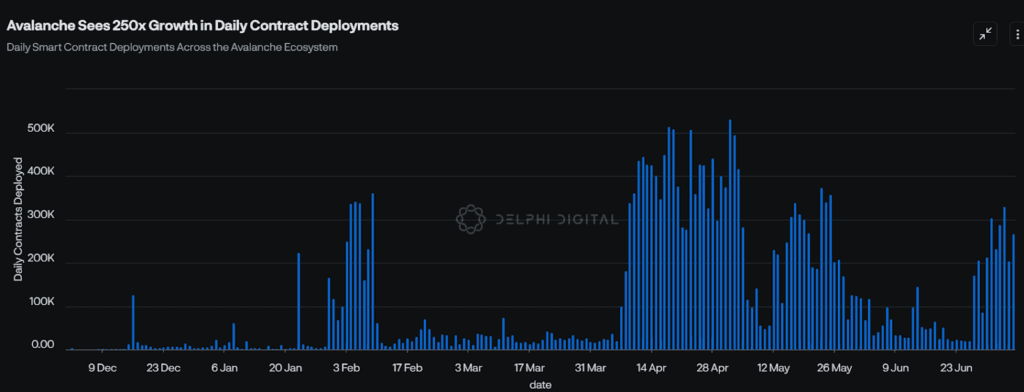
Building on Solidity’s familiarity, the C-Chain’s full EVM compatibility lets developers use the same op-codes, even logs, and the transaction semantics to build smart contracts on top of them. Due to this, developers do not need to redo everything from scratch if they are coding in Solidity—porting Ethereum dApps becomes a quick tweak just. This has fueled the 250x YoY surge in deployments to an average of 250K per day in mid-2025.
Avalanche’s Snowman Consensus is a linear, blockchain-optimized protocol using a gossip-based voting model for high-throughput ordering. The Snowman consensus is purpose-built through a gossiping model where those use-cases that need unlimited scalability can look forward to deploying on Avalanche because Snowman’s gossiping helps in attaining unlimited scalability—up to 4,500 TPS with sub-second finality.
Due to this, developers get the best environment to choose the consensus model that can help them create the smart contracts that they want, like real-time perps, tokenization platforms, or stablecoin use cases, without the drag of slower chains.
Projects Using These Custom Features to Deploy:
Avalanche’s DeFi TVL doubled to $2.1 billion since April 2025, driven by Etna upgrades, institutional RWAs ($550M+ inflows), and gaming surges. Here are the top projects on C-chain: TraderJoe, Benqi, GMX, Aave V3, Play of the Grid game, etc.
For example,
”Avalanche consensus is well-suited for building DeFi applications due to its scalability features, particularly its high throughput and near-instant finality. The deployment of the AAVE Protocol on Avalanche will allow users to leverage low transaction costs without compromising the security of the network.”
Despite being a new entrant launched by the Coinbase exchange in 2023, Base has shown resilience by launching over 21,700 contracts in a single day in March 2025, as per Token Terminal data, with cumulative deployments hitting a record 11.4 million that week alone.
And the influx in the usage of Base is because it has launched smart upgrades, easing smart contract developments like;
Base is fully EVM-compatible as an OP Stack L2, so you write smart contracts in Solidity just like on Ethereum and leverage familiar tools and standards without any compatibility headaches. This lets devs focus on creative logic for consumer apps or DeFAI, with smooth deployment via wallets like Coinbase. This enables rapid prototyping in a low-fee environment.
Base allows the usage of Hardhat through which you can quickly fork an environment that replicates Ethereum and build your application on top of it. So, instead of building everything from scratch to mirror Ethereum, you get a launchpad ecosystem to launch your application, test complex interactions like perps or prediction markets in a simulated mainnet without real costs.
You also get the Superchain perks as part of Optimism’s ecosystem, where Base shares unified bridges, liquidity, and governance with other OP Stack chains. This enables devs to deploy contracts that tap cross-L2 composability without building bridges, and benefit from collective security and incentives like the 2025 SuperStacks rewards pilot for DeFi liquidity. This interconnected setup helps multi-chain apps, like AI agents routing trades across Base and Optimism, with sub-cent fees keeping things scalable.
For time-sensitive contracts, Base’s 2025 Flashblocks upgrade delivers 200ms block times and lets smart contracts confirm in near-real-time. This is ideal for high-frequency gaming or memecoin launches where latency could kill user engagement.
OnchainKit—a Coinbase-backed SDK—simplifies integrations with macros for wallets, social logins, and on-ramp APIs, cutting dev time for consumer dApps by handling boilerplate so you can prioritize UX in Crypto x AI or DePIN projects.
Projects Using These Custom Features to Deploy:
Base’s DeFi TVL has climbed to $4.5B+ by October 2025, fueled by Superchain interests and Coinbase’s user onboarding, with 1B+ transactions YTD. The top Base projects are Morpho, Aerodrome, Pendle, etc.
For example,
BNB Chain is a high-volume powerhouse for smart contracts, with verified deployments reaching 2.6 million by mid-2025. This surge was driven by a DeFi TVL increase to $17 billion—up 120% YoY—fueled by memecoin mania and AI upgrades.
Daily contract creations averaged 5,000–7,000 in Q3, per Token Terminal, as devs flock to its EVM roots and 2025 hard forks like Maxwell. BNB Chain also has Solidity compatibility. And the influx in the usage of BNB Chain is because it has launched smart upgrades, easing smart contract developments like;
The Maxwell (live Q2 2025) upgrade supercharges execution by slashing block times to 0.75 seconds and finality to 1.875 seconds. It can handle up to 5,000 TPS for congestion-free runs, which is ideal for memecoin launches or prediction markets where delays could mean lost alpha.
As apps demand more, opBNB kicks in with EVM parity and 10,000+ TPS at ultra-low fees. This lets contracts batch off-chain for gaming or NFTs, AI agents without mainnet bottlenecks, while settling securely to BNB.
BNB keeps costs ultra-low at a base of 0.05 Gwei per txn—following two major 2025 slashes (first 10x to 0.1 Gwei in May, then 2x again in October, a total 20x reduction.
For user-centric builds, the Pascal hard fork introduced EIP-7702 in Q1 2025, enabling smart contract wallets with batch txns and gas abstraction—streamlining UX for DeFAI agents or RWAs without custom bundlers.
Projects Using These Custom Features to Deploy:
BNB Chain’s ecosystem hit $17B DeFi TVL by October 2025, with 10M daily txns and 500M+ unique addresses dominated by DEXes and lending amid memecoin and GameFi booms. The top projects on BNB Chain are PanCake Swap V3, Venus Protocol, Solv Protocol, Thena, Alpaca Finance, etc.
For Example,
Prolitus has been exceptional all these years when it comes to developing robust, scalable, and secure smart contracts for your niche-based requirements. By providing all the necessary tooling, integration partners, and harnessing years of research and expertise, Prolitus has been instrumental in providing a custom experience to clients when they are getting their smart contracts developed on their preferred blockchains.
So far, we have been serving clients of all shapes and sizes scattered across various geographical locations. Using our seasoned professionals with years of experience, we have provided the best outcomes to clients.
If you are looking for expertise, innovation, and comprehensive support to streamline a smooth digital transformation, we are always eager to help. For queries about how we can streamline the process and help you build your custom smart contract for your specific Web 3 use-cases, be it gaming, DeFi, NFTs, RWAs, DePin, or more, we are just a call away from you.