Why Smart Contract Development Services are a Must-Have Advantage in 2025?
September 11, 2025
share


share
Businesses today operate in an environment where trust, speed, and accuracy are non-negotiable. Whether it’s finance, supply chain, healthcare, or digital marketplaces, traditional contracts often slow things down with layers of intermediaries, paperwork, and human oversight. Smart contracts, which are self-executing programs running on blockchains, are changing this equation. They automate agreements, minimize errors, and ensure transparency, while reducing costs and delays.
But while the idea sounds simple, developing secure and business-critical smart contracts requires deep technical expertise, compliance awareness, and years of blockchain engineering experience. This is where specialized smart contract development services come in, helping businesses unlock automation with guaranteed security, faster time to market, and reliable long-term support.
Smart contracts are pieces of code deployed on blockchain networks that execute predefined actions automatically when certain conditions are met. Unlike traditional agreements, they don’t require third-party oversight or manual enforcement—they run on “if/then” logic that’s tamper-proof once deployed.
Here are the benefits smart contracts offer to businesses of any size and type:

Key Business Benefits of Smart Contracts in 2025:
These benefits make smart contracts a compelling choice, but achieving them demands a structured, secure, and well-audited development process.
This is the core decision. On paper, an internal team can “learn and build.” In reality, the cost of unknown unknowns in blockchain is uniquely high because smart contracts are public (if you choose), composable, and frequently target-rich for attackers. Below, we expand the seven most material reasons companies choose expert services—and add the operational color leaders needed for a board-level decision.
When a business first enters Web3 or upgrades from Web2 systems, the hardest part is not writing code but making the right architectural choices. Do you build on Avalanche L1s for its privacy and compliance configurations, or deploy on Arbitrum Orbit AnyTrust chain with similar features? Should your developers work with Solidity, Rust, Move, or one of the dozen-plus widely adopted smart contract languages in 2025? What are the honest advantages and disadvantages of each stack when everyone is promoting low gas, full customization, high TPS, etc.? What additional integrations will you need down the line?
If you ask individual protocols, they will inevitably vouch for their own stack. In-house teams, especially those new to blockchain, often lack the ecosystem-wide perspective to challenge that bias. A professional smart contract development service steps in as an unbiased advisor, mapping your business goals to the right platform, language, and integrations. Because they’ve delivered across chains, industries, and regulatory contexts, they can compare trade-offs and prevent vendor lock-in.
This role as a neutral guide is critical at the start: choose the wrong stack or language, and you may find yourself boxed into higher costs, missed integrations, or unnecessary rewrites later. With experienced services, you gain clarity and make choices aligned with your business outcomes.
A surprising proportion of high-profile incidents comes from logic bugs. Reentrancy, access-control lapses, price-oracle manipulation, signature malleability, unchecked external calls, and more similar issues — all are known classes of failure that specialized firms have muscle memory for. Security-first smart contract development services enforce threat modeling at design time, use proven libraries and patterns, and run multi-stage audits (manual audit, differential testing, fuzzing, invariant checks) to catch issues invisible to surface-level QA. They follow established security standards, such as GDPR, ISO, and SOC 2, while embedding practices that anticipate adversarial conditions. Crucially, they also understand composability risk: how your contract behaves when another protocol calls it in unexpected sequences or economic states.
An in-house team can learn these patterns, but the apprenticeship cost is paid in production risk. Services amortize that risk across many projects—so opting for smart contract development services means you buy the outcome, resilience, and avoid the trial-and-error.
Their experience across diverse clientele means they have seen, fixed, and hardened against the most common exploits before. For businesses where even a single bug could mean reputational and financial disaster, external expertise is the safer bet.
“Working code” isn’t the same as “production-ready code.” A smart contract might run as expected in a test environment, but production demands accuracy under edge cases, composability with other protocols, and efficiency that minimizes gas usage or fine-tuned access control. Development services excel here by applying agile methodologies with well-defined sprints, rigorous testing, and staged testnet deployments.
They bring accuracy not just in logic but in execution—integrating telemetry, meaningful event logs, and clear upgrade paths. Their operational efficiency comes from frameworks and architectures they’ve refined across dozens of projects, which dramatically reduces wasted cycles. For the business, this translates into faster time-to-market and guaranteed outcomes, without sacrificing resilience.
Hiring blockchain engineers, security auditors, and DevOps to build and maintain in-house capabilities is often expensive. Add the hidden costs—months of ramp-up, specialized training, third-party audits you’ll need regardless, and the maintenance overhead of keeping pace with evolving blockchain ecosystems. This kills your optimal window of launch.
Smart contract development services completely change this model. You get project-based engagement or customized support, paying only for what you need. This not only lowers upfront CAPEX but also reduces ongoing OPEX by eliminating the need to keep a permanent in-house team for occasional contract updates. Combined with their ability to optimize contracts to cut gas fees and computational costs, integrate on-demand services and legacy tools, and more. This financial case often tilts strongly in favor of outsourcing your smart contract development services.
Smart contracts don’t live in isolation; they interact with user wallets, exchanges, governance mechanisms, compliance frameworks, and real-world assets. This requires a cross-functional team of blockchain developers, architects, security auditors, compliance specialists, and domain experts.
Smart contract development services offer exactly that—a dedicated team with multi-industry experience spanning DeFi, RWAs, BFSI, Automotive, Telecom, and dozens of enterprise clients. Their exposure to almost all web3 verticals equips them to anticipate challenges that a first-time internal team might miss. Having this competence at your disposal means your business logic gets translated into hardened code by professionals who understand not only blockchain but also the business context in which it operates.
One size never fits all in blockchain. A DeFi lending protocol requires entirely different logic and controls than an insurance claims processor or a digital product passport for supply chains. With in-house teams, you’re often constrained by their specific skill sets and toolkits.
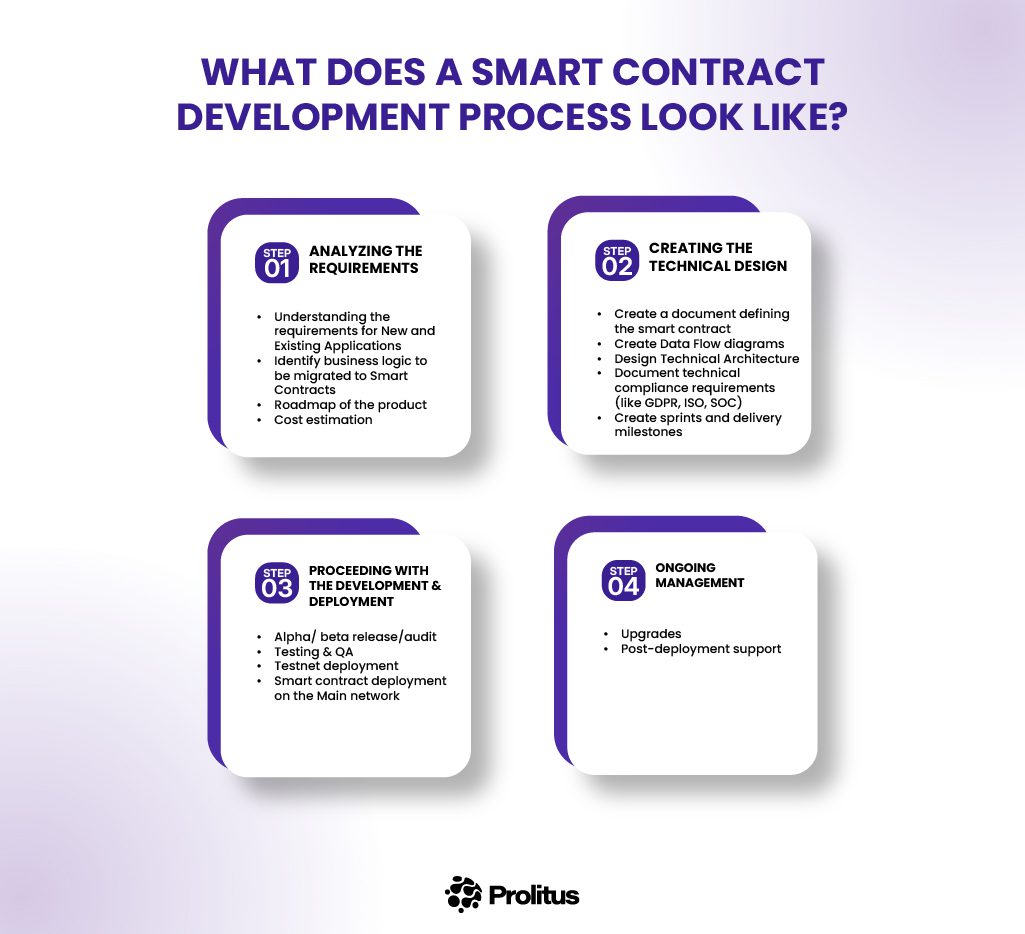
Professional services, however, operate on a project-based model, tailoring solutions to your precise business logic and industry requirements. They start with deep requirements analysis, define data flows, technical architecture, and compliance needs, and only then move into iterative development. This ensures your contracts are not just technically correct but also aligned with your business goals.
Deployment isn’t the finish line; it’s the start of continuous operations. Smart contracts require monitoring for performance, upgrades to adapt to ecosystem changes, and incident response when unexpected events occur. An in-house team may lack the bandwidth or global coverage to handle these needs around the clock. Or simply, it could be an infrastructure support team on standby round the clock with very minimal work, increasing your monthly burn.
Development services provide 24×7 support aligned with client time zones, ensuring you have experts on call whenever issues arise. Their long-term partnerships, often lasting over a decade across global clients, reflect the importance of sustained engagement. From bug fixes and gas optimizations to handling regulatory updates or network migrations, having post-launch support guarantees peace of mind and business continuity.
Smart contracts are increasingly being scrutinized by regulators, especially in industries like finance, healthcare, insurance, and similar. An in-house team may struggle to stay updated on shifting requirements across geographies, exposing your business to compliance risk.
Smart contract development services are built with compliance at their core. They adhere to AML/KYC, GDPR, SOC, and ISO frameworks, ensuring your contracts meet global regulatory standards. By embedding compliance checks into design and documentation, they make integration seamless and auditable. This not only protects you legally but also inspires confidence in partners, investors, and customers who demand assurance that your systems are enterprise-grade and regulator-ready.
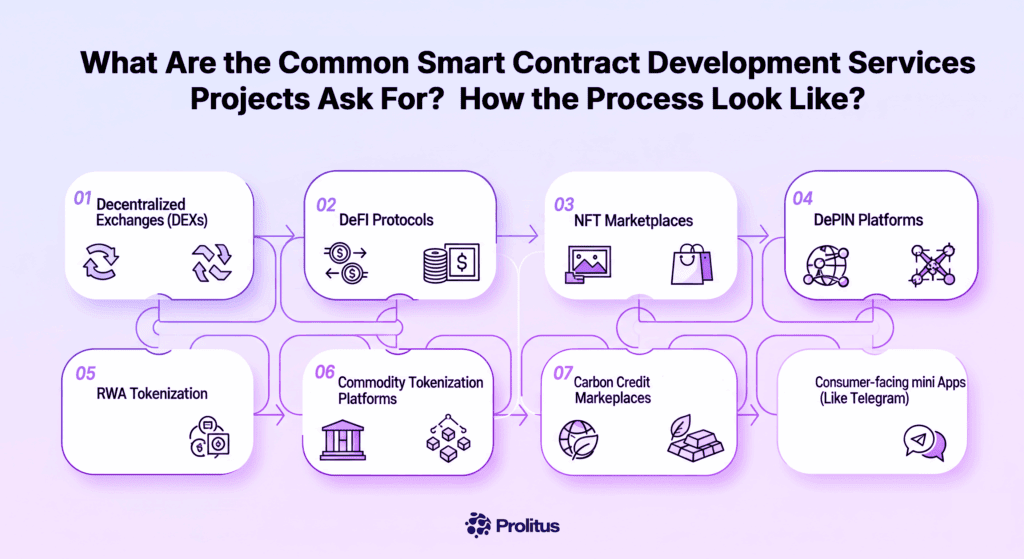
Projects come with diverse requirements, but in 2025, certain applications are seeing much higher traction than others. The shift from Web2 to Web3, rising institutional adoption, and consumer-facing integrations are pushing demand for specific types of smart contracts.
And when they come to a smart contract development service platform, here’s how they take this forward:
Choosing the right partner for your smart contract is about trust, compliance, and long-term confidence. Prolitus brings blockchain expertise across industries, with years of experience supporting everything from DeFi platform developments and tokenization projects to healthcare, logistics, and consumer applications. Every contract is built with a security-first approach, rigorously audited and aligned with global compliance standards like GDPR, ISO, and SOC.
Our teams operate on agile, cost-efficient models, helping businesses reduce time-to-market and operational costs while maintaining enterprise-grade quality. From strategy and architecture design to deployment and continuous monitoring, Prolitus offers end-to-end smart contract development and advisory, ensuring your business logic is translated into reliable, production-ready code. And with 24/7 technical support and long-term partnership models, you’re never left without guidance when your contracts need upgrades or adaptations.
If your next move depends on business-critical smart contracts, make sure you’re building with confidence. Connect with the Prolitus team today and take your project from vision to enterprise-grade reality.