Your Competitors Found the Best Framework for Blockchain Development — Did You?
October 21, 2025
share
What did click in your head when you read the title” Your competitors found the best framework for Blockchain Development — Did You”? FOMO, because if you have so far not transitioned, you are in a disadvantageous situation and if you have already transitioned but stuck with a less performant blockchain platform, you too can meet the same fate like TradeLens. But fret not anymore, because we are going to suggest the best blockchain frameworks that can help you quickly transition on-chain in a frictionless manner. So without any further ado, let’s quickly look at some of the best frameworks to choose for your development pursuits;
Top Frameworks To Pick In 2025 For Launching Your Application On Blockchain in 2026
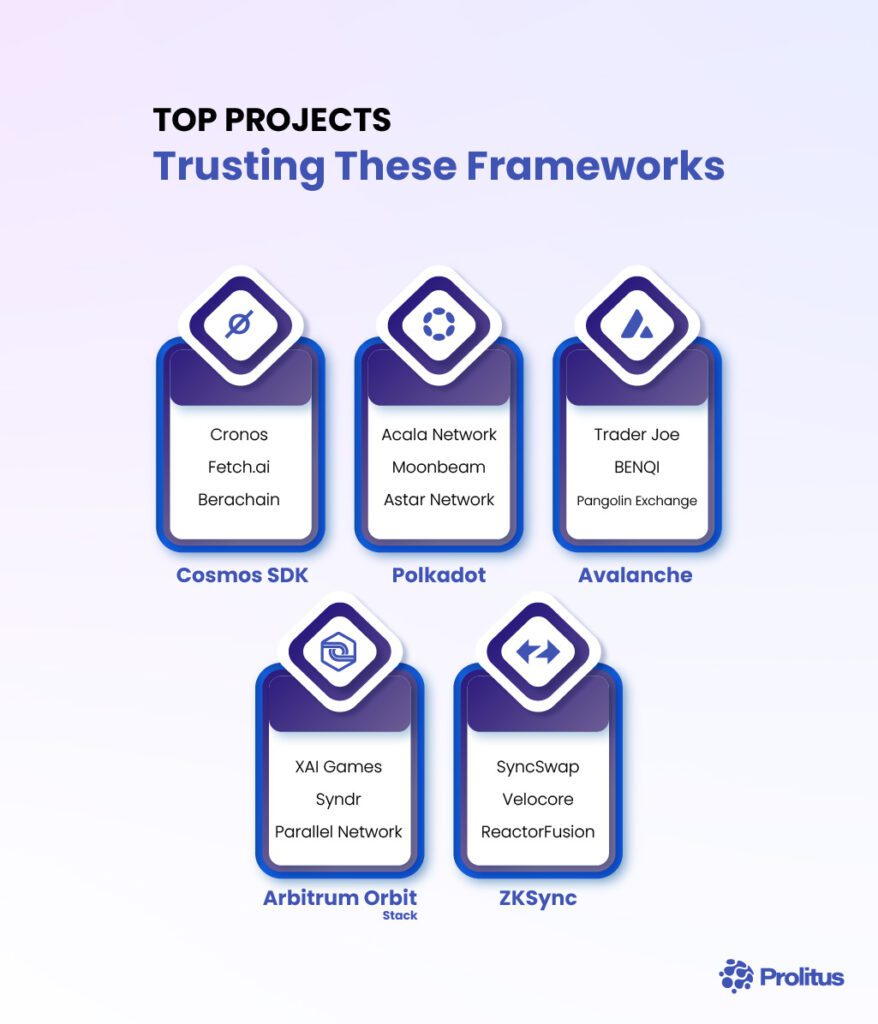
Cosmos SDK
Cosmos SDK has a track record of faster finality and high TPS. Due to this, 76818 repos and 750 projects deployed trust Cosmos. But if you are thinking that only these two features move the needle of the Cosmos SDK when it comes to developers choosing this framework,maybe you need to rethink this all over again because these are just the tip of the iceberg, the real game begins when developers get this;
Go Rust Cash Outs: All this while when you first thought of developing a blockchain for your solution, language was the biggest barrier to cross for developers. But Cosmos SDK has addressed this from the grounds up using the Go language. So, the learning curve is instantly minimized and you can quickly develop using the Cosmos SDK and launch your chain in a flash without having to learn a new language. Your Rust or Go proficiency would be enough to kick off instantly.
Modularity: As a developer, you need modularity and composability, which makes faster development cycles possible. With the help of the Cosmos SDK framework, you experience absolute modularity/ customizability because you can use/ reuse the existing modules to build specific features suiting your project requirements. To do that, Cosmos SDK has introduced the CLI/Scaffold that would help developers create a full blockchain template with autogenerated modules to build your own chain in a flash. As a result of this, you experience an accelerated development cycle and quick time to market your product.
App Specific Blockchains with Interop: Usually when you are deploying your solution on top of a blockchain, speed and scalability are a few concerns putting you on the backfoot. But not with the Cosmos SDK because you can build your own blockchain catering to high TPS, scalability without isolating yourself in the process because of IBC.
The one of keys to accomplish it is The Internet of Blockchains.
Only IBC has – Universal Standards – Sovereignty – Highest Security Design by Light Clients
Doesn’t have – Token and revenue model tied to the protocol itself.
Polkadot was formerly known for its shared security, Interop and substrate features, due to which parachain deployment flooded over the years with 40 to 50 active making up this year itself. But these reasons are only scratching the surface because developers want more customization and ease of development that Polkadot delivered in 2025 due to the following operational rollouts like;
Custom Runtime Logic: There are more than 40 core runtime logic to use that can power staking, governance, balances, assets, and identity. Due to this, it is possible to reverse engineer all the existing logics and build everything as per the requirement of a project without having to build everything from scratch. In this way, it can save a lot of time for developers.
JAM Upgrades: Through the JAM Upgrade, now it is much easier for developers to explore multiple ecosystems because the JAM upgrade breaks the chain into multiple independent blockchains of its own. So, they can deploy in any language and use any third party solutions for DA to create a more custom application as per the need.
Cumulus: There’s a provision where you can connect as a rollup because you do not want to deploy your own validator set. In its place, you can use the Polkadot ecosystem validator and pay them on a “ pay-as-per-use” basis. This is done via the Cumulus upgrade where developers get the chance to quickly spin up their standard substrate blockchain into a compatible parachain. So, you can quickly deploy block proofs, peer-to-peer messaging, and communication with Relay Chain validators without the need to build everything from scratch.
The new Polkadot SDK is now live, giving devs the power to build their own chain, their own rules, and their own future.
Here is why this matters
→ The Polkadot SDK is a fully open, modular, production ready framework for building… pic.twitter.com/lMwzFqRyyK
— The Crypto Professor (@TheCryptoProfes) June 9, 2025
Avalanche
Avalanche is stealthily delivering when it comes to usage because over the years, there has been robust growth in the subnets deployed, a testament of its growth. For example, in May 2022, there were only 23 operational subnets which grew to 40 in 2024 and by 2025, there’s almost 100+ active/custom subnets deployed. But what is driving the momentum of development on Avalanche, let’s find out;
Etna Upgrade: The Aetna Upgrade has significantly cut the development cost by 99%. So, instead of validating the P-Chain of Avalanche by staking 2000 AVAX, now developers get a pay as you use model when they want to come and develop their application on top of the Avalanche chain.
ACP-125: The ACP 125 is another major upgrade that has significantly pulled the fees down and eased development. For example, instead of developers paying very high fees to test the development cycle, with ACP 125, the base fee has been reduced to 1 AVAX, significantly amplifying development. Developers are saying that the ability to launch your own C chain is much faster and simple with these updates.
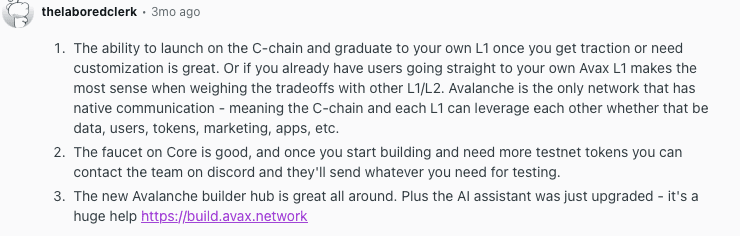
eERC: eERC pulls the string to enforce privacy that developers have lauded when it comes to building on Avalanche because now you can hide token balances and at the same time, enjoy protocol level independence. These trade-offs with EVM compatibility means, you need not have to change a single line of code if you are on Ethereum and want to transition to Avalanche on the go to use or benefit from all these updates. Here’s what a developer shared his experience building on top of Avalanche on sub-reddit;
And this is not just it, Usman Asim, a developer relation engineer at ChainStack said while attending the developer spotlight that, “ he needed the following, a blockchain with leading speed, decentralization, and flexibility. An architecture that could incorporate ZKs for privacy-centric goals. And a framework that can help him customize his own Rust VM to fine-tune an ideal execution environment.” And guess what, Avalanche delivered everything that he rightfully wanted, making him keep Avalanche as top 5 blockchains on his radar for development. So, it kind of makes sense when you see institutions swarming to build on top of Avalanche and if you are someone, why wait any longer. In case you want something more. Let’s unwind the next blockchain framework on this list.
Arbitrum Orbit Stack
Arbitrum isn’t growing, but it is compounding ever since 2024 because more than 900+ applications and more than 90+ orbit chains have been deployed so far.And these numbers are spiralling because there are certain add-on delivered that has simply made development almost feel like a cakewalk like;
Stylus: As a developer, the first thing you want is the ease to develop on the go without hassles. With Stylus, you get the full compatibility with any programming language, be it Solidity, Vyper, or any EVM bytecode, use Hardhat, Truffle, and Remix to deploy your smart-contract easily.
BoLD: BoLD upgrade lets developers inherit the same level of security as that of Arbitrum without having to bring their own validators to launch their chain. This benefit completely eliminates the barrier to deploy your own application on top of Arbitrum with your own custom rules and sovereign operational environment.
Grants & Rewards: Arbitrum foundation also helps in streamlining development to innovate the ecosystem through grants with programs like DRIP & Gaming Catalyst earmarking a whopping $200M to help developers undertake development and win prize money to fund their development.
@arbitrum, on the other hand, is Ethereum’s leading Layer 2 scaling solution.
Arbitrum’s infrastructure, especially through Arbitrum One and the Orbit stack, makes it easy for companies to build fast, low-cost, scalable blockchains.https://t.co/4A8jIFTJnP
Right at this moment, there are over 300+ Dapps and 6 million wallets with more than 200+ projects who are waiting to deploy on ZKSync post their mainnet launch. Such an influx of development on the ZKSync ecosystem is happening because the developers are getting unprecedented benefits smoothing development. And these are all happening because ZKStack provides a mix of a public-private operations via;
ZKSync Prividium: You need just the ZKStack CLI to instantly launch your own private chain. In this way, developers can still operate on a public chain while inheriting full sovereignty to build anything with respect to institutional grade use-cases like finance with advantages like privacy with control, built in compliances, Ethereum Anchor and Interop, scalability and super performant operations.
Native Account Abstraction: This is a major go if you want to build anything on blockchain. With the NAA, it is super easy to onboard users because developers can go for gasless onboarding unavailable on most of the other stacks of choice.
High Scalability: Developers are looking for very high scalability but in a cost efficient manner. With the help of ZkStack, state updates are possible via a transaction output. Due to this trade-off, it is very easy to significantly cut the cost and develop.
All the above frameworks mentioned are robust choices that you can take to undertake development in 2026. But at any point, if you are feeling like getting stuck for no reason, you can always contact an expert to help you. That’s where Prolitus can make a world of difference and quickly help you launch your solution.
Launch Your Own Dapp Using the Best Blockchain Framework with Prolitus
Prolitus has a proven track record of building on top of blockchains for the last 10 years. You can launch various platforms from Dapps, marketplaces, exchanges, financial apps to gaming apps and more using Prolitus as a development partner to deploy on top blockchains as mentioned above in this piece. From custom support to full fledged development, Prolitus can undertake everything that you are seeing.
So far, we have served multiple projects meeting their requirements in Web 3 gaming, NFTs, Dex and exchange and a couple of other segments as well. We can do the same for you as well by using our seasoned professionals having years of experience. If you are looking for a development friendly experience where you get expertise, innovation, and comprehensive support occurring in tandem to build your applications, we are here to help you. For queries about how we can streamline the process and help you in developing your application on top of the blockchain of your choice, we are just a call away from you.