Top 5 Perpetual DEX Models to Study Before You Launch Your Own in 2025
November 17, 2025

share


share
The perpetual DEX market just hit a milestone that should make every builder pay attention: $1.3 trillion in monthly trading volume, capturing 26% of the entire global crypto derivatives market. To put that in perspective, just two years ago, perp DEXs barely registered at 2.7% of the market. This is a fundamental change in how traders approach leveraged crypto trading in 2025, and that’s the opportunity for new builders.
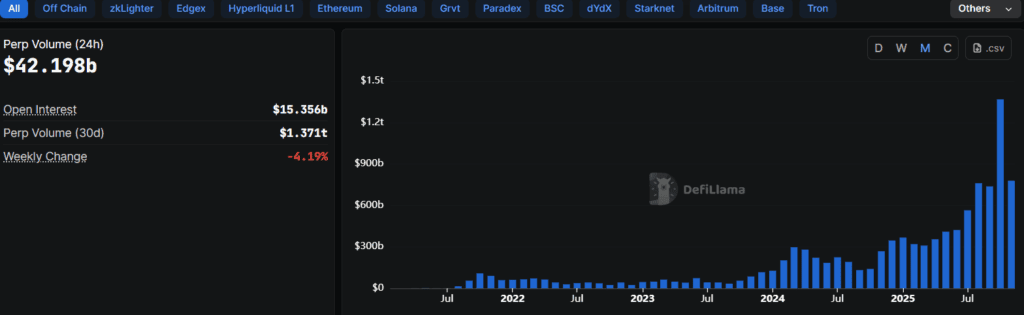
But here’s the thing: not all perp DEXs are built the same. The infrastructure choice you make on day one will determine whether you’re processing billions in volume or struggling to gain traction. After analyzing the top performers in 2025, five distinct architectural models have emerged as clear winners, each with its own playbook for success.
Let’s break down what’s actually working.
Think building your own blockchain for perpetual dex sounds crazy? Hyperliquid and dYdX would disagree. These platforms control 60%+ of the entire perp DEX market by owning their entire stack. And the numbers back it up; they’re proof that when performance is non-negotiable, custom infrastructure wins.
Hyperliquid sits at $4.42 billion TVL, processing $13.1 billion in daily volume with 73% market share in decentralized perps. The platform generates $1.15 billion in annual revenue with just 11 employees.
They were the institutional pioneer for Perp Dex. dYdX migrated to its own Cosmos SDK appchain in 2022 from an ETH L2 and now maintains $203 million in TVL with support for over 200 markets.
1.They executed a major architectural migration without losing their user base. The team successfully evolved from an Ethereum L2 to a dedicated Cosmos chain. This complex migration retained its user base while achieving the 50x leverage, scalability, and performance needed for its institutional target.
2.They prioritized institutional infrastructure over retail. From the beginning, dYdX focused on professional trading infrastructure, institutional-grade APIs, and compliance features. This attracted consistent, high-volume institutional flow without relying on the unpredictable retail incentive farming or promotional trading.
3.They built mature governance that adapts to market conditions. The platform’s mature DAO-driven tokenomics allow it to adapt to market conditions. dYdX’s recent community vote increased buybacks from 25% to 75% of protocol fees, with 59.38% approval and over 89 million DYDX tokens voting. The decision is a great example of a responsive governance structure that aligns long-term value with token holders.
4.What’s the negative? They proved that first-mover advantage fades without continuous innovation. Their revenue declined year-over-year to $1-2 million monthly. So, the challenge for dYdX now is maintaining market leadership when newer platforms are coming up with superior user experience.
Leading platforms here are Lighter, Aevo, and GRVT. If building a whole blockchain sounds unnecessary for you, an L2 could be a compelling middle ground where you can get Ethereum’s security with purpose-built derivatives infrastructure.
This category exploded in 2025, with over $11 billion in daily volume and $1.25 billion TVL, which proves you don’t need a custom L1 always to compete at scale.
Lighter is a Founders Fund, Ribbit Capital, and Haun Venture-backed Perp protocol and raised $68 million at a $1.5 billion valuation. Lighter hit $1.18 billion TVL with $7.92 billion in daily volume, reaching $12.78 billion in 24-hour peaks.
1.They used zero-knowledge proofs to solve the institutional trust problem. Lighter uses zero-knowledge proofs for verifiable order matching and liquidations. For an institution, this is the holy grail. They get the privacy of an off-chain book and the cryptographic proof that they weren’t front-run or screwed over by the exchange.
2.They leveraged Ethereum’s security to focus on trading optimizations. By building a custom ZK-rollup, Lighter got sub-10ms latency without the headache of building and securing a new L1 consensus layer. They focused their firepower on trading-specific optimizations and let Ethereum handle the core security.
3. Regulatory-First Design is another great feature of Lighter. They were built with MiCA compliance in mind from day one. It was in their core design principle. This regulatory moat makes it one of the only “safe” on-ramps for traditional finance to enter the on-chain perp market.
4. They built a professional infrastructure that commands sustainable fees. Lighter’s institutional-grade APIs rival traditional derivatives platforms and attract high-volume traders who generate fees independent of token incentives. They’ve expanded beyond crypto to FX perpetuals like GBP/USD with 25x leverage and target traditional traders seeking familiar assets with crypto-native execution. Professional traders are sticky, and once integrated, switching costs become real moats.
Pantera Capital and Binance Labs-backed derivative platform Aevo maintains $30.7 million TVL with a focus on both perpetuals and options. They support Greeks calculations and have $12 million daily volume at highest across 100+ markets on their custom Optimism rollup.
1. They carved out a niche through product differentiation. While most perp DEXs focus solely on perpetual futures, Aevo integrated options trading using its custom Optimism rollup. This enables advanced strategies like capped strikes and spreads that are uncommon among competitors. The hybrid approach of offering both perps and options under one roof attracted sophisticated traders who need multiple instruments for complex strategies.
2.They built on proven L2 infrastructure to ship faster. By deploying on the OP Stack with Optimistic Rollup technology, Aevo handled up to 5,000 transactions per second while settling on Ethereum, without building blockchain infrastructure from scratch. The hybrid architecture mirrors successful platforms: off-chain orderbook for sub-second matching, onchain settlement for transparency. This lets them focus on derivatives innovation rather than infrastructure problems.
GRVT reached $36.9 million TVL with $1.43 billion in volume, securing $33.3 million in funding with regulatory Class M licensing in Bermuda for compliant privacy trading across 72 markets.
1. They built a privacy-first architecture that satisfies regulators. GRVT’s zkSync Validium balances privacy and auditability. Traders get confidential execution while regulators can verify compliance. This enabled RFQ (request for quote) models for institutions requiring privacy, while the Bermuda Class M licensing created competitive moats in institutional markets. They proved you can have both privacy and regulatory compliance when designed correctly from the ground up.
2. They focused on institutional clients from day one. With 55 institutional clients and partnerships with major trading firms, GRVT secured natural liquidity without depending on retail incentive farming. This strategic focus attracted high-value customers, generating sustainable fees rather than chasing vanity metrics through unsustainable rewards.
There is a saying: “Don’t build a new world, just build the best damn skyscraper in a city that’s already booming.” These perp dexes were built on this ideology. They picked one ecosystem (like Solana, Base, or Tron) and leverage its unique, native strengths to build a product that simply couldn’t exist anywhere else.
Leading platforms here are Pacifica, Drift, Jupiter for Solana; Avantis on Base; Sunperp for Tron, etc. Let’s look into them now.
Pacifica surged to $40 million TVL with $527 million in daily volume within months of mainnet launch and surpassed established competitors like Jupiter in volume metrics. They’re processing 10,000+ active users with cumulative volume hitting $10.5 billion.
1.They optimized every aspect of Solana’s architecture. Pacifica achieves sub-millisecond settlement through Solana-specific program optimizations. They support TIF=TOB (Time-In-Force equals Take-Or-Book) orders that create win-win liquidity incentives. This enables market makers and takers to benefit simultaneously, and create orderbook depth that rivals centralized exchanges. These optimizations only work on Solana; you can’t port this to Ethereum and expect similar performance.
2.They integrated AI in ways only possible on high-throughput chains. Pacifica’s AI-powered smart trading tools and automated risk management require high-frequency blockchain interactions that would cost prohibitive gas fees on Ethereum. Features like automated hedging process thousands of micro-transactions for risk management are only feasible when transactions cost fractions of a penny. This created genuine technical differentiation rather than superficial UX improvements.
3.They timed mainnet launch to capture ecosystem momentum. Launching amid Solana’s $89 billion TVL uptrend, Pacifica captured network effects as the entire ecosystem grew. They integrated deeply with Solana DeFi protocols for LST (liquid staking token) collateral, boosting capital efficiency without bridge friction. This drove 248% quarter-over-quarter growth according to Messari data.
4. They used community building to create exclusivity before scaling. The closed beta with invitation codes and points system created FOMO while building an engaged user base before full launch. Zero-fee BTC/ETH markets attracted retail traders, while public APIs fostered developer integrations. This balanced approach captured both retail and professional segments.
Drift maintained $1.02 billion TVL with $300-400 million in daily volume across 60+ markets, offering 50x leverage while growing 248% quarter-over-quarter to capture 28% of Solana’s perp market share.
1.They pioneered yield-bearing collateral for maximum capital efficiency. Drift’s hybrid vAMM + JIT (Just-In-Time) liquidity model lets traders use SOL liquid staking tokens as margin for 101x leverage positions. This cross-margined approach means capital earns yield even while backing leveraged trades.
2.They built deep ecosystem integrations that create network effects. Partnerships like Titan Exchange for automated liquidations and LST management enhanced composability, integrating with 20+ Solana protocols for organic liquidity flows. Each integration strengthens the others. When users stake on Drift, that capital becomes trading collateral, which generates fees, which attracts more stakers. These flywheels only work with deep native integration.
3.They implemented sustainable tokenomics without inflationary emissions. The 70% fee distribution to DRIFT stakers built long-term value alignment independent of market cycles. While many platforms inflate supplies to maintain activity, Drift proved fee-sharing creates sustainable growth. Their governance via DRIFT staking enabled adaptive protocol evolution responding to user needs rather than team preferences.
4.They used Solana’s low costs for experimental features. Ultra-low transaction costs enabled experimental prediction markets and micro-transaction features impossible on expensive chains.
Jupiter’s aggregator-perp hybrid boasts $4.06 billion TVL with $300-400 million in daily volume, ranking top-3 in DeFi revenue with 100x leverage across core markets. They command 95% of Solana DEX aggregation market share.
1.They evolved from aggregator to full DeFi superapp. Jupiter didn’t build an isolated perps platform, they leveraged their position as Solana’s primary swap aggregator to create seamless flows between swaps, perps, and lending. Users stay within Jupiter’s ecosystem for multiple DeFi activities, creating cross-product network effects. Each service strengthens the others through shared liquidity and user flows.
2.They built the JLP pool model for zero-slippage execution. Users trade against pooled assets (SOL, ETH, wBTC, USDC, USDT) and earn guaranteed execution at oracle prices with no slippage. JLP holders receive 70% of trading fees. This capital efficiency attracted sticky liquidity providers who became long-term stakeholders rather than mercenary yield farmers.
3.They created ecosystem ownership through transparent governance. JUP token governance with clear fee distribution mechanisms built community loyalty. Their $137 million IDO funded ecosystem grants foster loyalty through actual value creation. The 40% year-over-year wallet growth to 12 million actives shows genuine adoption.
4.They’re building vertical integration with JupUSD stablecoin. The partnership with Ethena Labs for JupUSD stablecoin backed by U.S. Treasury assets via BlackRock’s digital fund represents strategic infrastructure control. Replacing $750+ million in existing stablecoins with a native asset gives Jupiter control over its financial infrastructure while creating additional revenue streams. This reduces reliance on external stablecoins while deepening ecosystem moats.
Avantis on Base reached $111 million TVL with $260 million in daily volume, offering 500x leverage on real-world assets like forex and commodities across 94 markets, with $59 million in 24-hour peak trades.
1. They pioneered tokenized RWA derivatives. While others focused on crypto, Avantis captured the underserved market for traditional asset trading on-chain. Offering forex and commodities with up to 500x leverage opened entirely new user segments. This gave traditional traders wanting crypto-native execution without learning crypto-native assets. This first-mover advantage in RWA perps created a defensible niche.
2. They innovated with zero-fee perps that only charge winning trades. Rather than charging all trades, Avantis only fees profitable positions. This removes barriers to entry and enables high-frequency strategies that generate volume through activity rather than per-trade costs. Base’s ultra-low fees made this model viable. It wouldn’t work on expensive chains where gas alone exceeds typical trading fees.
3. They built sophisticated risk management for liquidity providers. The tranche-based LP system isolates risk by market, enabling yields up to 200% without exposing providers to correlated liquidation risks. Loss-rebates incentivize balanced open interest, ensuring stability during volatility. This risk management attracted $12 million from Pantera and Founders Fund, who recognized the sustainable LP economics.
4. They leveraged Base’s positioning in Coinbase’s ecosystem. Native integration with Base provided access to Coinbase’s institutional network and regulatory relationships. The Robinhood debut generated $22 million in volume, proving traditional finance platforms see Base-native projects as lower-friction integration partners than multi-chain platforms.
Sunperp leverages Tron’s $80 billion USDT circulation for gasless perps, achieving $100 million+ in volume milestones within five weeks of beta launch with 20,000+ users and $1.8 billion cumulative volume.
1.They captured first-mover advantage in an underserved ecosystem. Despite Tron’s size ($80B USDT, millions of users), it lacked sophisticated derivatives infrastructure. Sunperp filled that vacuum, capturing pent-up demand from an established but underserved community. The rapid $100M milestone within weeks validated this thesis—sometimes being first in the right ecosystem beats being best in a crowded one.
2. They leveraged zero gas fees as a core competitive advantage. Tron’s gasless architecture enabled truly zero-cost perpetual trading impossible on Ethereum or even Solana. Combined with zero trading fees (100% directed to $SUN buybacks), Sunperp created the lowest-cost derivatives trading in DeFi. For high-frequency traders where fees compound rapidly, this cost structure becomes the primary decision factor.
Multi-chain platforms try to have it all: maximum accessibility, aggregated liquidity across ecosystems, and zero friction from bridges. The approach can create explosive growth. Aster briefly captured 40% of perp DEX market share—but sustainability becomes the challenge. These platforms prove scale is possible, but test whether you can maintain it.
Leading platforms here are Aster, EdgeX, Paradex. Let’s look into them one by one.
Aster has become the face of explosive, viral growth of perp dexes. Aster operates across BNB Chain, Ethereum, Solana, and Arbitrum with $1.44 billion TVL and a $2.35 billion in Open Interest with a mind-boggling 1001x leverage.
1. They used extreme incentives to drive explosive viral growth. Aster allocated 53.5% of total token supply to community airdrops and referral programs, creating exponential user acquisition at relatively low direct costs. Combined with extreme leverage offerings (up to 1001x), this created social media virality that attracted massive user bases rapidly. While long-term sustainability remains questionable, this proves well-designed incentive programs can achieve rapid scale when paired with genuinely differentiated features.
2. They eliminated cross-chain friction entirely through unified margin. Rather than forcing users to bridge assets manually, Aster implemented seamless cross-chain trading that abstracts away blockchain complexity. Unified margin across BNB Chain, Ethereum, Solana, and Arbitrum means users maintain one position across all chains. This infrastructure investment captured users from centralized exchanges who wouldn’t tolerate DeFi’s typical bridge friction.
3.They secured strategic backing that provided instant credibility. YZi Labs (CZ’s family office) investment and CZ’s public $2.5 million personal stake provided credibility money can’t buy. When the Binance founder publicly backs your platform, it signals legitimacy to skeptical users.
4.They offered yield-bearing collateral that reduces leverage costs. The unique system lets traders earn 5-7% on stablecoins while maintaining leveraged positions, effectively reducing the cost of leverage. For traders holding positions over time, this yield makes Aster’s economics competitive even with lower base leverage. The hybrid AMM-orderbook architecture balanced speed with decentralization.
5. The Sustainability Questions: The temporary DeFiLlama delisting over wash trading concerns highlighted how incentive-driven growth can create artificial metrics that damage credibility. Aster’s volume patterns also mirrored Binance’s structure too closely. This raises questions about organic growth. The platform captured 40% market share briefly but faces the crucial test: maintaining users post-incentive. Builders should keep in mind that extreme leverage (1001x) attracts regulatory scrutiny and creates existential risks.
EdgeX’s ZK-rollup across 70+ blockchains reached $485 million TVL with $5.7 billion in daily volume across 110 markets, generating $38 million in October revenue—a staggering 3,900% year-over-year growth.
1.They leveraged institutional incubation for immediate market access. Amber Group’s incubation gave them more than capital. It provided market-making expertise, trading firm relationships, and immediate liquidity in key Asian markets. The $400 million TVL surge (2,600% since April) came from institutional relationships that take competitors years to develop independently. This incubation fast-tracked credibility in professional trading circles.
2. They achieved true cross-chain interoperability through hybrid liquidity. Supporting 70+ blockchains with cross-chain messaging means users can trade without managing multiple wallets or bridge transactions. The hybrid liquidity layer enables 100x leverage without fragmentation. This infrastructure investment removed the biggest multi-chain pain point.
3.They prioritized professional infrastructure over retail features. StarkWare ZK-rollup technology with 200,000 TPS capability and sub-10ms latency enabled professional-grade trading, rivaling centralized exchanges. The pro APIs integrated with trading firms for natural depth, generating $38M October revenue from real activity rather than incentive farming. This professional focus commanded higher fees and attracted stable, revenue-generating users.
4.They maintained sustainable economics through real fee generation. With 0.012% maker fees focused on actual activity over incentives, EdgeX demonstrated sustainable business model before token launch. The 6,800% monthly volume growth to $137.5 billion came from genuine trader adoption. This revenue-first approach positions them for long-term viability post-TGE.
Paradex’s StarkNet appchain hit $142 million TVL with $926 million in daily volume, supporting 115 markets with zero-fee privacy trading and 50x leverage across 250+ trading pairs.
1.They built a custom appchain for derivatives-specific optimization. Rather than deploying on general-purpose chains, Paradex’s dedicated StarkNet appchain provides infrastructure optimized purely for derivatives trading. This reduced latency to CEX levels while maintaining self-custody through onchain settlement. The appchain approach gives them control over the full stack without building an entire L1 from scratch.
2.They innovated with zero-fee retail trading funded by market maker spreads. Instead of charging users trading fees, Paradex lets market makers earn through price improvement while retail trades for free. This removes barriers to entry and users can trade perpetuals without worrying about fees compounding on frequent trades. The model works because market makers provide natural liquidity without requiring incentive programs.
3.They secured Paradigm backing for deep liquidity bootstrapping. Paradigm’s investment provided more than capital—it provided access to institutional trading networks and credibility with professional traders. This backing enabled liquidity bootstrapping that drew institutional flows from launch. The strategic relationship matters as much as the dollar amount.
4. They’re building privacy features that satisfy both traders and regulators. The RFQ (request for quote) system and upcoming privacy layer address institutional needs for confidential trading without sacrificing regulatory compliance. ZK proofs enable private execution with public verifiability.
While others chase pure trading volume, multi-service platforms integrate perps within broader DeFi ecosystems. They’re proving that diversified revenue streams and sustainable yield models can outlast single-product competitors through multiple market cycles. Leading platforms here could be GMX, Gains Network, Jupiter, etc
1.GMX is the Real Yield OG that started it all, with a rock-solid $409 million TVL. It pioneered the GLP model, which is a shared liquidity pool where LPs act as the counterparty to all trades. Unified liquidity pools create capital efficiency compounding. GMX’s GLP model lets users provide liquidity once and earn fees from spot trading, perpetual funding, and liquidations simultaneously. Traders benefit from deeper liquidity and lower slippage while LPs enjoy sustainable yield without constant token emissions. This model generates genuine value for participants rather than shuffling treasury tokens around. It’s why GMX survived market cycles that killed competitors.
2.Revenue diversification reduces existential risk. Rather than betting everything on trading fees, these platforms generate income from lending spreads, liquidation penalties, cross-product arbitrage, and ecosystem service fees.
Jupiter’s pivot from aggregator fees to perps, lending, and staking rewards is a great example of how product diversification creates sustainable moats. When one product faces competition, others continue generating revenue.
3. Gains Network is differentiated through multi-asset synthetic derivatives. While competitors focused on crypto, Gains Network offered forex, stocks, and commodities from a single interface with up to 200x leverage. This expanded the addressable market beyond crypto traders to traditional traders seeking 24/7 access to familiar assets. Synthetic assets pioneered onchain access to traditional markets without requiring actual asset custody, opening entirely new revenue streams.
4. NFT-based LP positions of Gains Network added gamification elements that increased engagement beyond pure yield farming. This innovation attracted users who wanted more interesting interactions with their DeFi positions while still earning real yield. The gTrade v10 upgrade with funding fee model and counter-trade incentives enabled higher open interest caps and institutional adoption.
So, which path is yours? L1 full sovereignty of design, L2 Rollup for Ethereum alignment and low cost, Native DApp if you have a deep, obsessive understanding of one ecosystem (like Solana) and a clever idea to leverage its unique tech, Multi-Chain if you can solve the complexities of cross-chain aggregation and win on user experience and Multi-Service if your goal is long-term sustainability, capital efficiency, and building a DeFi bank where perps are one piece of a larger puzzle.
Whatever it may be, as an aspiring DEX builder, your focus should be on the vision, not the infrastructural hurdles. Prolitus can be your expert partner. With over 10 years of experience and 200+ delivered projects, we provide the development and infrastructure support to build, secure, and scale your platform, letting you focus on winning the market.
Choose your model, study the winners, and develop your Perpetual dex with Prolitus. The $1.3 trillion market is just getting started.